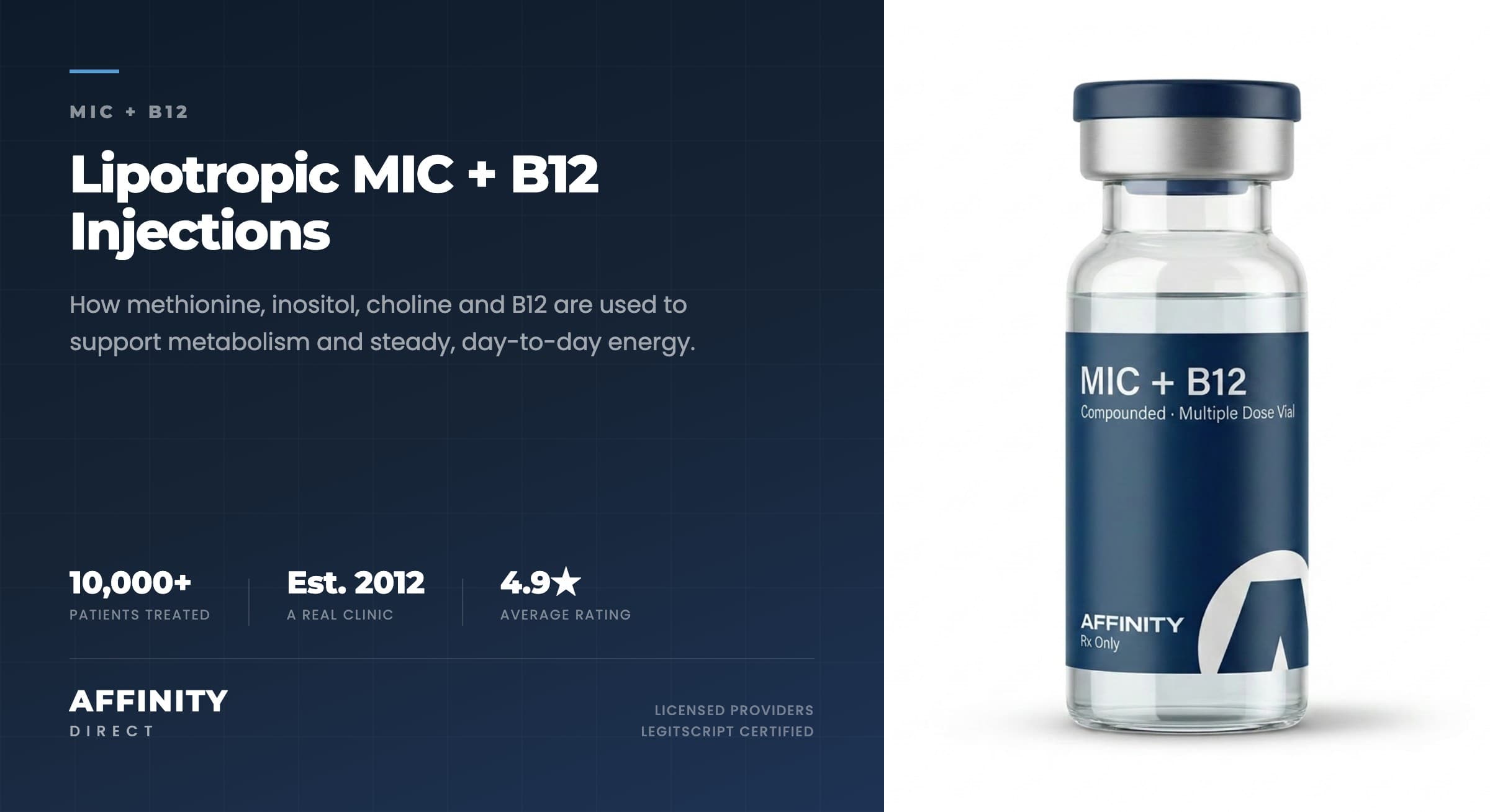
MIC + B12 is one of the most misunderstood items on any wellness menu. It is not a fat-burning drug, and it is not a shortcut. It is a blend of four nutrients your body already uses — Methionine, Inositol, Choline, and vitamin B12 — packaged as a single injection and used as a supporting tool alongside a real diet-and-exercise plan. This guide breaks down what each component does, what the word "lipotropic" actually means, and where the honest evidence begins and ends.
This is educational information, not medical advice. Whether a MIC + B12 injection is appropriate for you is a decision for a licensed provider who has reviewed your health history — not something you should decide from a blog post.
What does "lipotropic" mean?
"Lipotropic" literally means fat-loving, or more precisely, a substance thought to help move and metabolize fat in the liver. The liver is the body's central hub for processing fat, and certain nutrients are thought to support how it packages and ships fat out rather than letting it accumulate. Choline is the clearest example: it is an essential nutrient and, especially as phosphatidylcholine, it is needed to transport lipids out of the liver — when choline is insufficient, fat can accumulate in the liver.1
That is the entire logic behind a "lipotropic" injection: combine nutrients involved in fat and energy metabolism, deliver them together, and support the liver's normal handling of fat. Important nuance — supporting a metabolic pathway is not the same as a drug that causes weight loss. We will come back to that distinction, because it is where most marketing goes wrong.
The four ingredients, one at a time
Methionine (M)
Methionine is one of the nine essential amino acids — your body cannot make it, so it must come from your diet.2 In its active form, S-adenosylmethionine (SAMe), it donates methyl groups in a process called transmethylation that the body uses across countless cellular reactions.2 Because it is a sulfur-containing amino acid involved in methylation, methionine is included in lipotropic blends for its supporting role in normal liver metabolism. It is a building block your metabolism relies on — not a fat-loss agent in its own right.
Inositol (I)
Inositol (most commonly myo-inositol) is a sugar-like compound that acts as a second messenger in insulin signaling. The most studied use is in women with polycystic ovary syndrome (PCOS), where myo-inositol has been associated with improved insulin sensitivity and metabolic markers.3 Because insulin sensitivity is tied to how the body stores and uses energy, inositol earns its place in the blend. Worth being precise, though: most of that research is in specific populations and on oral supplements, and it is being studied rather than settled — it is not evidence that an injection drives weight loss.3
Choline (C)
Choline is the workhorse of the lipotropic story. It is an essential nutrient recognized since 1998, and the liver is central to its metabolism.1 Choline is needed to transport lipids out of the liver, and inadequate choline intake is associated with fat accumulating in the liver.1 The adequate intake for adults is roughly 550 mg/day for men and 425 mg/day for women, and the body cannot synthesize enough on its own to meet its needs.1 This is the most direct rationale for the "lipotropic" label.
Vitamin B12 (the "+ B12")
Vitamin B12 is required for healthy red blood cell formation, DNA synthesis, and normal nervous-system function.4 Deficiency can cause fatigue, weakness, and pale skin, among other symptoms.4 Here is the part most ads leave out: while B12 is often promoted as an energy booster, supplementation appears to have no beneficial effect on performance in the absence of a nutritional deficit.4 In plain terms — if you are genuinely low in B12, restoring it may help you feel less wiped out; if your levels are already normal, more B12 is unlikely to give you an energy "lift."
Quick reference: what each part contributes
| Component | What it is | Studied / associated role |
|---|---|---|
| Methionine | Essential amino acid | Methylation (via SAMe); supports normal fat processing in the liver2 |
| Inositol | Sugar-like compound | Insulin signaling; associated with improved insulin sensitivity in PCOS research3 |
| Choline | Essential nutrient | Transports lipids out of the liver; deficiency associated with liver fat1 |
| Vitamin B12 | Essential vitamin | Red blood cell formation, DNA synthesis; deficiency causes fatigue4 |
The honest take on weight loss
Here is where we are deliberately blunt, because you deserve it. MIC + B12 injections are not FDA-approved for weight loss, and the clinical evidence that they cause weight loss on their own is limited. Research has not confirmed that these injections are effective for weight loss, and they are not a substitute for healthy habits.5 Any honest source will tell you the same thing: pair them with a sensible diet and regular exercise.5
So why do some people use them? Because the components support metabolic pathways — fat transport in the liver, insulin signaling, energy metabolism, red blood cell health — and because, for someone correcting a B12 shortfall, feeling less fatigued may make it easier to actually stick to the workouts and food changes that do the heavy lifting. The shot is a supporting role in a weight-management program, not the lead actor. If a clinic tells you a lipotropic injection alone will melt fat, walk away.
It is also worth understanding what you are buying. Affinity Direct's MIC + B12 is a compounded medication prepared by a licensed U.S. compounding pharmacy and requires a valid prescription after a licensed provider reviews your intake. Compounded products are not FDA-approved, and this use is off-label.5 That is a different thing entirely from gray-market "research chemicals" sold online with no provider, no prescription, and no pharmacy oversight. The provider relationship is the safeguard.
Who might it suit?
A MIC + B12 injection tends to be considered by people who are already committed to a structured nutrition and exercise plan and want adjunct support — particularly those who may be running low on B12 (for example, some older adults, people who eat little animal protein, or those with absorption issues), since that is the group most likely to feel a real difference in fatigue.4 It is not a fit for anyone hoping to skip the diet-and-exercise work, and it is not a treatment for any disease.
The only way to know whether it makes sense for you is an evaluation. The MIC + B12 page lays out the specifics, and the peptide therapy hub covers the full menu. If your real goal is broader cellular energy rather than weight management, you might also look at NAD+ therapy, which is associated with mitochondrial energy pathways. Not sure where to start? The 60-second match quiz points you toward the option that fits your goals, and a licensed provider reviews every intake before anything is prescribed.
Common questions
Are MIC + B12 injections the same as a weight-loss drug like a GLP-1?
No. GLP-1 medications are FDA-approved weight-management drugs with a different mechanism — and to be clear, Affinity Direct does not offer GLP-1s; our compounded menu is the five peptides listed on the hub. MIC + B12 is a nutrient blend used as an adjunct to diet and exercise; it is not FDA-approved for weight loss and the evidence for standalone fat loss is limited.5 The two are not interchangeable.
Will the B12 in the shot give me an energy boost?
It depends entirely on whether you are deficient. B12 is essential for red blood cells and energy metabolism, and a deficiency can cause real fatigue — but supplementation appears to do nothing for energy or performance if your levels are already adequate.4 A provider can help determine where you stand. For a fuller look at energy support, see our guide to peptides for energy and focus.
Why include choline specifically?
Choline is the most direct reason these shots are called "lipotropic." It is an essential nutrient needed to move lipids out of the liver, and low choline is associated with fat building up in the liver — so it is thought to support the liver's normal handling of fat.1 Most people do not get the adequate intake from diet alone.1
Is this a prescription, and is it safe?
Yes — at Affinity Direct, MIC + B12 is a compounded medication that requires a valid prescription after a licensed provider reviews your intake, usually within 24 hours. Compounded products are not FDA-approved and this use is off-label, which is exactly why provider oversight matters.5 If you would like to understand the safety and regulatory picture across our menu, read are peptides safe and legal. You are charged at checkout with a full refund if a provider does not approve treatment.
This article is for general education and is not medical advice. These statements have not been evaluated by the FDA. These products are not intended to diagnose, treat, cure, or prevent any disease. Compounded medications require a valid prescription from a licensed provider. For investigational/wellness use only. Talk with a licensed Affinity Direct provider about whether peptide therapy is right for you.