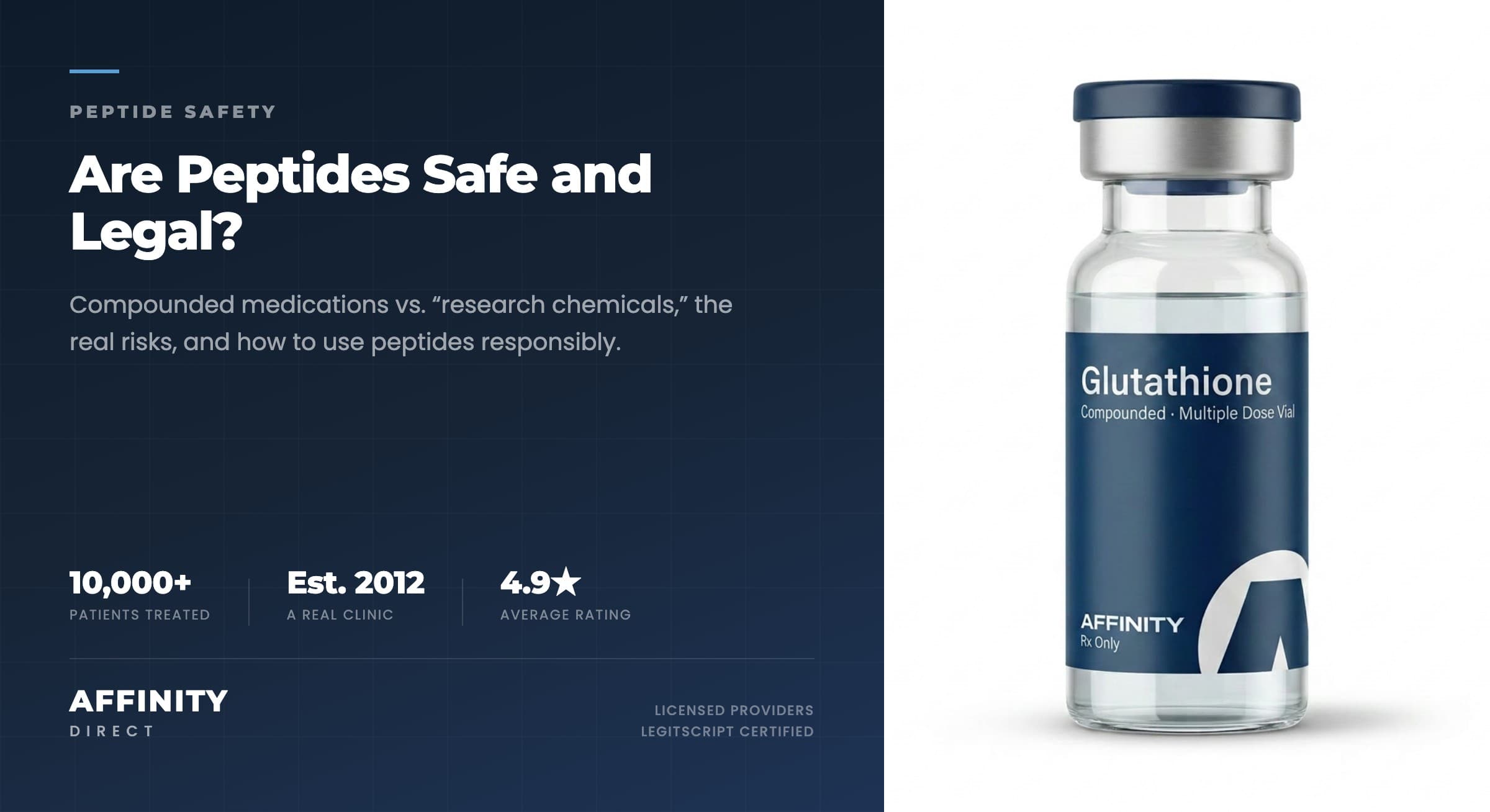
"Are peptides safe?" and "are peptides legal?" are really the same question wearing two hats, and the honest answer to both is: it depends almost entirely on where the peptide comes from and who is involved. A peptide prescribed by a licensed provider and prepared by a regulated U.S. pharmacy is a very different thing from a vial bought online labeled "research use only — not for human use." This article is education, not medical advice, and it is meant to help you ask the right questions before you start. The decision itself should always be made with a licensed provider who has reviewed your health history.
At Affinity Direct we are the online arm of a real Midwest clinic network — Affinity Whole Health, established in 2012, with four locations and more than 10,000 patients treated. That matters here, because the single biggest safety variable with peptides is whether a real clinician and a real pharmacy stand behind the product. Below is the plain-English version of what is legal, what is not, and who should steer clear.
The real safety line: prescribed and compounded vs. "research chemicals"
The riskiest corner of the peptide world is the gray market: wellness spas, social-media sellers, and websites that ship vials of "research grade" peptides stamped "research use only" or "not for human use" 1. These vendors typically operate with no prescription, no clinical oversight, and no assurance of purity or correct dosing. Investigative reporting has documented that what arrives "may or may not be" the peptide on the label, and that the manufacturing process can introduce impurities such as bacteria or heavy metals 2.
That is fundamentally different from a peptide that is prescribed by a licensed provider and compounded by a licensed U.S. pharmacy for a specific patient. In that model, the active ingredient comes from a facility subject to inspection, the pharmacy is overseen by a state board of pharmacy, and a clinician has reviewed whether the therapy is appropriate for you 2. Affinity is the second kind — a real clinic that routes to a licensed compounding pharmacy, never a gray-market reseller.
If a product is sold without a prescription, labeled "not for human use," or shipped from an unverified overseas vendor, treat it as a red flag, not a bargain.
What "compounded" and "not FDA-approved" actually mean
Most wellness peptides are compounded medications, and many of their uses are off-label. Both terms get thrown around loosely, so here is what they really mean.
Compounded means a medication is custom-prepared by a licensed pharmacist (or physician) in a state-licensed pharmacy, tied to an individual patient's prescription 3. Compounded drugs are not FDA-approved — there is no process verifying that product's safety, effectiveness, or quality before it reaches you, the way there is for a mass-manufactured approved drug 3. That is not the same as "illegal." Compounding is a long-standing, lawful part of medicine; it simply places more responsibility on the prescriber and pharmacy, which is exactly why the clinic behind the prescription matters.
Off-label means a licensed provider is prescribing a medication for a use other than its specific FDA-cleared indication — a routine, legal part of practice that should be a deliberate clinical decision, not a marketing claim.
| Term | Plain-English meaning | What it does NOT mean |
|---|---|---|
| Compounded | Custom-prepared by a licensed pharmacy for one patient's prescription | Not "homemade" or unregulated; the pharmacy is state-licensed |
| Not FDA-approved | FDA did not pre-review this exact product's safety, effectiveness, or quality | Not automatically illegal; responsibility sits with the prescriber and pharmacy |
| Off-label | A legal prescription for a use beyond the FDA-cleared indication | Not experimentation done on you without a provider's judgment |
| "Research chemical / not for human use" | An unregulated gray-market product with no clinical oversight | This is the genuinely risky category — avoid it |
In 2023 the FDA moved a list of peptides into a more restricted compounding category, citing safety concerns including the recognized risk that injectable peptides can trigger immune reactions 2. The peptides Affinity offers are limited to a specific menu — glutathione, sermorelin, NAD+, MIC + B12, and PT-141 — each prescribed only after a provider reviews your intake.
Are they legal? Yes — through the right channel
For the products Affinity offers, the legality question turns on the channel, not the molecule. A peptide a licensed provider prescribes and a licensed pharmacy compounds for you is inside the regulated medical system; the same substance bought as a "research chemical" with no prescription is outside it. Some peptides also have a narrow FDA-approved version: bremelanotide (PT-141) is FDA-approved as Vyleesi for hypoactive sexual desire disorder (HSDD) in premenopausal women only — any other use, including in men or for general libido, is off-label 4. Affinity offers PT-141 in compounded form; read the full picture on the PT-141 page.
Peptide side effects: what's generally reported
Side effects vary by peptide, dose, and person, and the most honest thing to say is that high-quality long-term human safety data is limited for many wellness uses — much of what is known comes from animal studies or narrow clinical populations 1. That is precisely why provider oversight matters. Reported effects tend to fall into a few categories:
- Injection-site reactions — redness, swelling, soreness, or itching where the medication is administered.
- Systemic, short-term effects — for example, nausea, facial flushing, and headache are among the most commonly reported side effects with bremelanotide (PT-141) 4.
- Fluid retention and aches — for growth-hormone-releasing peptides such as sermorelin, reported effects can include swelling or edema and joint discomfort 5.
- Immune or allergic reactions — injectable peptides carry a recognized risk of immune responses, which is part of why the FDA tightened compounding rules 2.
Warning signs that warrant prompt medical attention include trouble breathing, throat or facial swelling, hives or a spreading rash, chest pain, fainting, a severe headache, or signs of infection at an injection site such as expanding redness, warmth, pus, or fever. These are general flags, not a complete list; report anything unusual to your provider.
Who should not use peptides (without a serious provider conversation)
Some people should avoid peptide therapy or proceed only after careful evaluation. This list is not exhaustive — it is exactly what the match quiz and provider review are designed to catch:
- Anyone pregnant, trying to conceive, or breastfeeding.
- People with a current or past cancer diagnosis, or a strong family history — some peptides influence growth-signaling pathways, so this needs a provider's judgment.
- People with significant heart disease or uncontrolled high blood pressure — for example, the prescribing information for bremelanotide (PT-141) advises against use in people with uncontrolled high blood pressure or known heart disease 4.
- People with serious kidney, liver, or endocrine conditions, or active infections.
- Anyone with a known allergy to a specific peptide or an excipient.
- Minors, and anyone on medications that could interact.
The takeaway: peptides are not a casual supplement. They are prescription therapies that deserve a real medical conversation.
How a real clinic lowers the risk
Most of the danger in the peptide world isn't the molecules themselves — it's the channel. A legitimate clinic reduces risk at every step: a licensed provider reviews your intake and history before anything is prescribed, the prescription is filled by a licensed U.S. compounding pharmacy rather than a gray-market vendor, and there is an accountable relationship if something doesn't feel right. With Affinity, you complete a short intake, a licensed provider reviews it (usually within 24 hours), and you are charged at checkout with a full refund if a provider does not approve treatment. Orders ship free and discreet in two days with syringes and alcohol prep pads included. For deeper background, start with our peptide therapy guide, see the real numbers in our cost breakdown, or read how to get peptide therapy online.
Common questions
Are peptides legal in the United States?
The peptides Affinity offers are legal when prescribed by a licensed provider and compounded by a licensed pharmacy for an individual patient. What is genuinely problematic is the unregulated gray market — products sold without a prescription and labeled "research use only" or "not for human use" 1. The same substance can sit inside the regulated medical system or outside it; the channel is what counts.
Are compounded peptides FDA-approved?
No. Compounded medications are not FDA-approved, which means there is no process verifying that specific product's safety, effectiveness, or quality before it is marketed, the way there is for mass-manufactured approved drugs 3. That is why the prescriber and the licensed pharmacy carry the responsibility — and why a real clinic relationship matters.
What are the most common peptide side effects?
It varies by peptide. Injection-site reactions are common across the board; bremelanotide (PT-141) is associated with nausea, facial flushing, and headache 4, while growth-hormone-releasing peptides like sermorelin are associated with reported effects such as swelling or edema and joint discomfort 5. Long-term human safety data is limited for many wellness uses, which is part of why provider oversight is important 1.
How do I know if peptide therapy is right for me?
You don't decide alone — that is the point of a provider review. Take the 60-second match quiz to see which option, if any, may fit your goals, then a licensed provider evaluates your intake before anything is prescribed. If it is not appropriate, it won't be approved, and you are refunded.
This article is for general education and is not medical advice. These statements have not been evaluated by the FDA. These products are not intended to diagnose, treat, cure, or prevent any disease. Compounded medications require a valid prescription from a licensed provider. For investigational/wellness use only. Talk with a licensed Affinity Direct provider about whether peptide therapy is right for you.