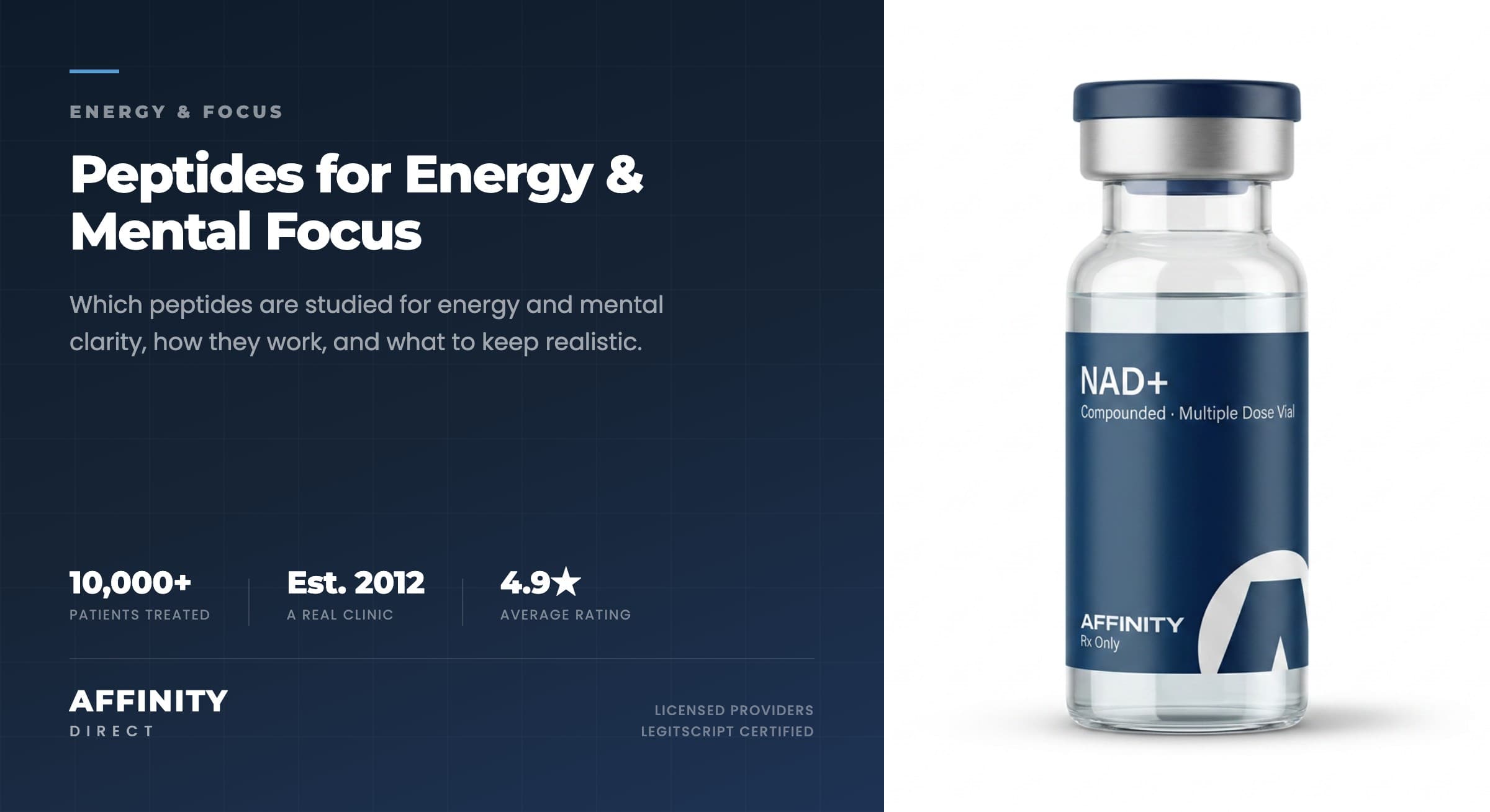
If you have been searching for a peptide or injectable that "boosts energy," it helps to start with an honest distinction. Nothing on our menu is a stimulant, and none of it works like a cup of coffee. What a few of these options are associated with is supporting the underlying biology your cells use to make and spend energy — which is a slower, more foundational idea than a quick lift. This article is educational, not medical advice; only a licensed provider can tell you whether any of this is appropriate for you.
Among the five options Affinity Direct offers, two are the ones people most often ask about for energy and mental clarity: NAD+ and MIC + B12. Below is what each one actually does at the cellular level, what the research supports, and — just as important — where to keep your expectations grounded.
Why "energy" is a biology question, not a marketing word
The energy your body runs on is a molecule called ATP (adenosine triphosphate), produced mostly inside your cells' mitochondria. When people say they feel "low energy," that can mean a dozen different things — poor sleep, stress, low iron, thyroid issues, an actual nutrient deficiency, or simply being run down. That is exactly why a provider review matters: feeling tired is a symptom, not a diagnosis, and the right answer depends on the cause.
The two options below relate to energy in genuinely different ways. NAD+ is tied to the machinery of cellular energy production itself. MIC + B12 leans on the role B12 plays in normal metabolism and red blood cell formation. Neither is a substitute for addressing sleep, nutrition, or an undiagnosed medical issue.
NAD+ : the coenzyme at the center of cellular energy
NAD+ (nicotinamide adenine dinucleotide) is a coenzyme found in every living cell, and it sits right in the middle of how cells turn food into usable energy. In the mitochondria, NAD+ accepts electrons to become NADH, which then feeds the electron transport chain that drives oxidative phosphorylation — the process that produces the bulk of your ATP.4 In other words, NAD+ is not a fuel; it is part of the engine that burns fuel.
NAD+ also acts as a cosubstrate for a family of enzymes called sirtuins, which are involved in metabolic regulation and are frequently discussed in longevity research.4 A key reason NAD+ gets attention for aging and energy is that NAD+ levels are observed to decline with age across multiple tissues, which is associated with reduced mitochondrial function.4 That decline is the biological rationale people point to when they look at NAD+ to support energy and cellular health.
What the research actually supports — and what it doesn't
Here is where honesty matters. Studies in humans suggest that NAD+ precursors can raise NAD+ levels safely: a randomized, placebo-controlled trial found that chronic nicotinamide riboside supplementation was well-tolerated and effectively elevated NAD+ in healthy middle-aged and older adults.5 That is a meaningful finding. But the same researchers were careful to note that the functional benefits still need to be confirmed in larger, more targeted clinical trials before strong conclusions can be drawn.5
So the accurate framing is this: NAD+ is central to cellular energy metabolism, levels fall with age, and supplementation can raise those levels — but claims that it will reverse aging, fix fatigue, or sharpen focus run well ahead of the evidence. Much of the longevity-focused research is still early or preclinical. Injectable NAD+ is a compounded medication, is not FDA-approved for these wellness uses, and any such use is off-label. If you want the full picture, our NAD+ therapy deep dive walks through the mechanism and the caveats in more detail, and you can review the product itself on the NAD+ page.
MIC + B12 : the role of B12 in normal energy metabolism
MIC + B12 combines three lipotropic compounds — Methionine, Inositol, and Choline — with vitamin B12. The energy conversation around this blend is really a conversation about B12, so it is worth being precise about what B12 does and does not do.
Vitamin B12 is genuinely essential. According to the NIH, B12 is required for the development and function of the central nervous system, healthy red blood cell formation, and DNA synthesis, and it serves as a cofactor for key metabolic enzymes.1 More broadly, the B vitamins help your body get or make energy from the food you eat.3 Because B12 is needed to build red blood cells that carry oxygen, a shortage can leave you running on less.
That connection to tiredness is well documented. Fatigue and lack of energy are recognized symptoms of vitamin B12 deficiency anemia, alongside pale skin, shortness of breath on exertion, and lightheadedness.2 So if someone is genuinely low in B12, correcting that deficiency can reasonably be associated with feeling less depleted.
The honest catch most ads skip
The NIH is blunt on the point that matters most for marketing claims: although B12 is often promoted as an energy enhancer and performance booster, B12 supplementation appears to have no beneficial effect on performance in the absence of a nutritional deficit.1 Translation: if your B12 is already normal, more B12 is unlikely to give you extra energy. The benefit is tied to correcting a shortfall, not to topping off a tank that is already full.
This is exactly why a provider review is the right first step rather than self-treating. The Methionine, Inositol, and Choline components are most often used as an adjunct to a nutrition-and-exercise weight-management program, not as a standalone weight-loss treatment, and the evidence for that combination is limited. MIC + B12 is a compounded, off-label combination that is not FDA-approved. You can read the breakdown on our MIC + B12 explainer or see options on the MIC + B12 page.
NAD+ vs. MIC + B12 at a glance
| NAD+ | MIC + B12 | |
|---|---|---|
| What it is | A coenzyme central to cellular energy production | Lipotropic blend (Methionine, Inositol, Choline) plus vitamin B12 |
| Energy connection | Feeds mitochondrial ATP production; levels decline with age4 | B12 supports normal energy metabolism and red blood cell formation1 |
| Strongest evidence | Supplementation can raise NAD+ levels in adults5 | Correcting a B12 deficiency is associated with relief of fatigue2 |
| Keep realistic | Functional/anti-aging benefits still need confirmation5 | Little added energy benefit if B12 is already normal1 |
| Status | Compounded, off-label, not FDA-approved | Compounded, off-label, not FDA-approved |
| Starting price | From $149 | From $125 |
Setting honest expectations
If you take one thing from this, let it be this: the strongest, clearest evidence here is about correcting deficiencies and supporting normal cellular machinery — not about manufacturing energy out of thin air. NAD+ is genuinely central to how cells make ATP, and B12 is genuinely essential to normal metabolism. Where the science gets thin is the leap from "essential" to "will dramatically boost a healthy person's energy and focus." We would rather tell you that up front than oversell it.
That is also why Affinity Direct uses a real clinical process. Affinity Direct is the online arm of Affinity Whole Health, a Midwest clinic network established in 2012 that has treated more than 10,000 patients. These are provider-prescribed, pharmacy-compounded medications dispensed by a licensed U.S. compounding pharmacy after a licensed provider reviews your intake — not unregulated gray-market "research chemicals." That distinction is the whole point: a provider can look at your history, consider whether your fatigue might have a treatable cause, and decide whether any of this is appropriate.
Feeling tired is a symptom, not a diagnosis. The fastest way to a real answer is a licensed provider who can evaluate the cause — not a label that promises a "boost."
Common questions
Will NAD+ or B12 give me an instant energy boost?
No — and be cautious of anything that promises that. These are not stimulants. NAD+ is part of the cellular machinery that produces energy, and B12 supports normal metabolism, but research does not support the idea that either delivers a quick, caffeine-like lift, especially if you are not deficient.1 Any effect is tied to supporting underlying biology over time, and individual results vary.
Do I need to be deficient for B12 to help my energy?
For energy specifically, the benefit is most clearly associated with correcting a deficiency. The NIH notes that B12 supplementation appears to have no beneficial effect on performance when there is no nutritional deficit.1 A licensed provider can help determine whether testing or treatment makes sense for you — this article is educational and not a substitute for that evaluation.
Is injectable NAD+ FDA-approved for energy or anti-aging?
No. Injectable NAD+ is a compounded medication, and its use for energy, focus, or longevity is off-label and not FDA-approved. Many of the longevity-related claims rest on early or preclinical research, so it is worth keeping expectations measured.45
Which one is right for me — NAD+ or MIC + B12?
That depends on your goals, your history, and what a provider finds. The simplest starting point is our 60-second match quiz, which points you toward the option that fits your situation. From there, a licensed provider reviews your intake — usually within 24 hours — before anything is prescribed. You can also browse all five options on the peptide therapy hub or read the broader peptide therapy guide to see how the whole process works.
This article is for general education and is not medical advice. These statements have not been evaluated by the FDA. These products are not intended to diagnose, treat, cure, or prevent any disease. Compounded medications require a valid prescription from a licensed provider. For investigational/wellness use only. Talk with a licensed Affinity Direct provider about whether peptide therapy is right for you.